MOTS-c: Mitochondrial-Derived Peptide for Energy Homeostasis and Anti-Aging
MOTS-c is a naturally occurring mitochondrial-derived peptide that acts as a systemic metabolic regulator, promoting energy balance, cellular resilience, and longevity.
Structural Parameters of MOTS-c
| Property | Value and Specification | References |
|---|---|---|
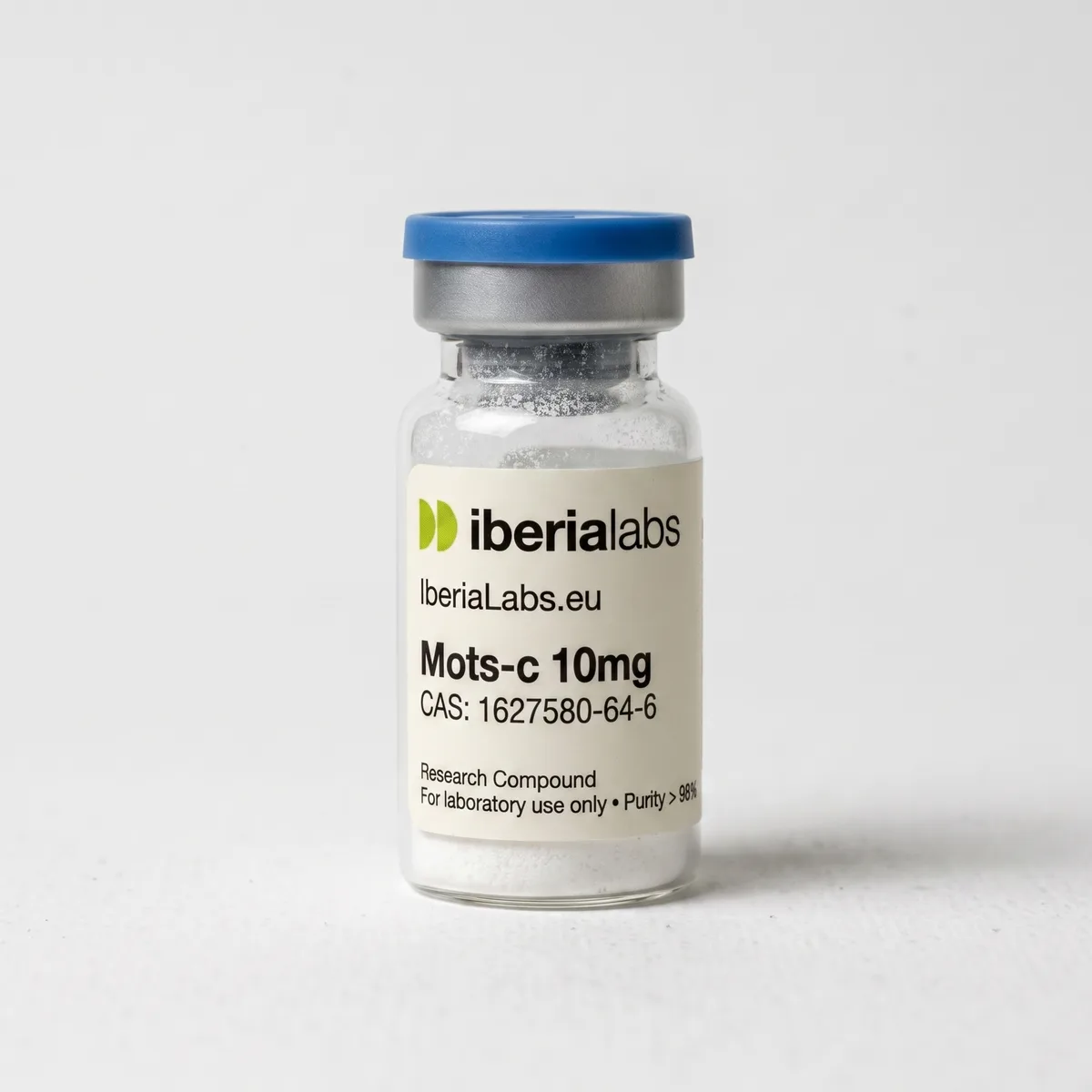
| CAS Number | 1627580-64-6 | |
| Molecular Formula | C101H152N28O22S2 (free base) | |
| Molecular Weight | 2174.62 g/mol | |
| Chemical Class | Mitochondrial-derived peptide (MDP / mitokine) | |
| Sequence | Met-Arg-Trp-Gln-Glu-Met- Gly-Tyr-Ile-Phe-Tyr-Pro-Ar g-Lys-Leu-Arg |
Origin, History, and Research Stage
MOTS-c was discovered in 2015 by Changhan Lee and Pinchas Cohen at the USC Davis School of Gerontology, establishing that mitochondria secrete active signaling peptides (mitokines). Because it significantly enhances exercise capacity and performance, the World Anti-Doping Agency (WADA) added MOTS-c to its prohibited list in 2024 under category S0. It remains an active area of pre-clinical study for metabolic health, skeletal muscle decline, and life extension.
Mechanism of Action and Pharmacokinetics
MOTS-c is a 16-amino acid peptide encoded by a short open reading frame (sORF) within the mitochondrial 12S rRNA gene. It acts as a cytoprotector and nuclear transcriptor. Under metabolic stress, MOTS-c translocation to the cytosol and nucleus occurs, where it increases intracellular AICAR levels. This triggers the activation of AMP-activated protein kinase (AMPK). AMPK activation upregulates the GLUT4 glucose transporter, facilitating insulin-independent glucose uptake into skeletal muscle, and modulates folate/one-carbon metabolism to enhance stress adaptation.
Scientific and Clinical Effects
In vivo animal studies show that MOTS-c prevents weight gain in mice fed a high-fat diet, reverses age-induced insulin resistance, and restores glucose tolerance in older animals to youthful levels. Furthermore, it enhances physical performance, increases grip strength, and improves neuromuscular coordination, making it a promising candidate for counteracting sarcopenia and age-related physical decline.