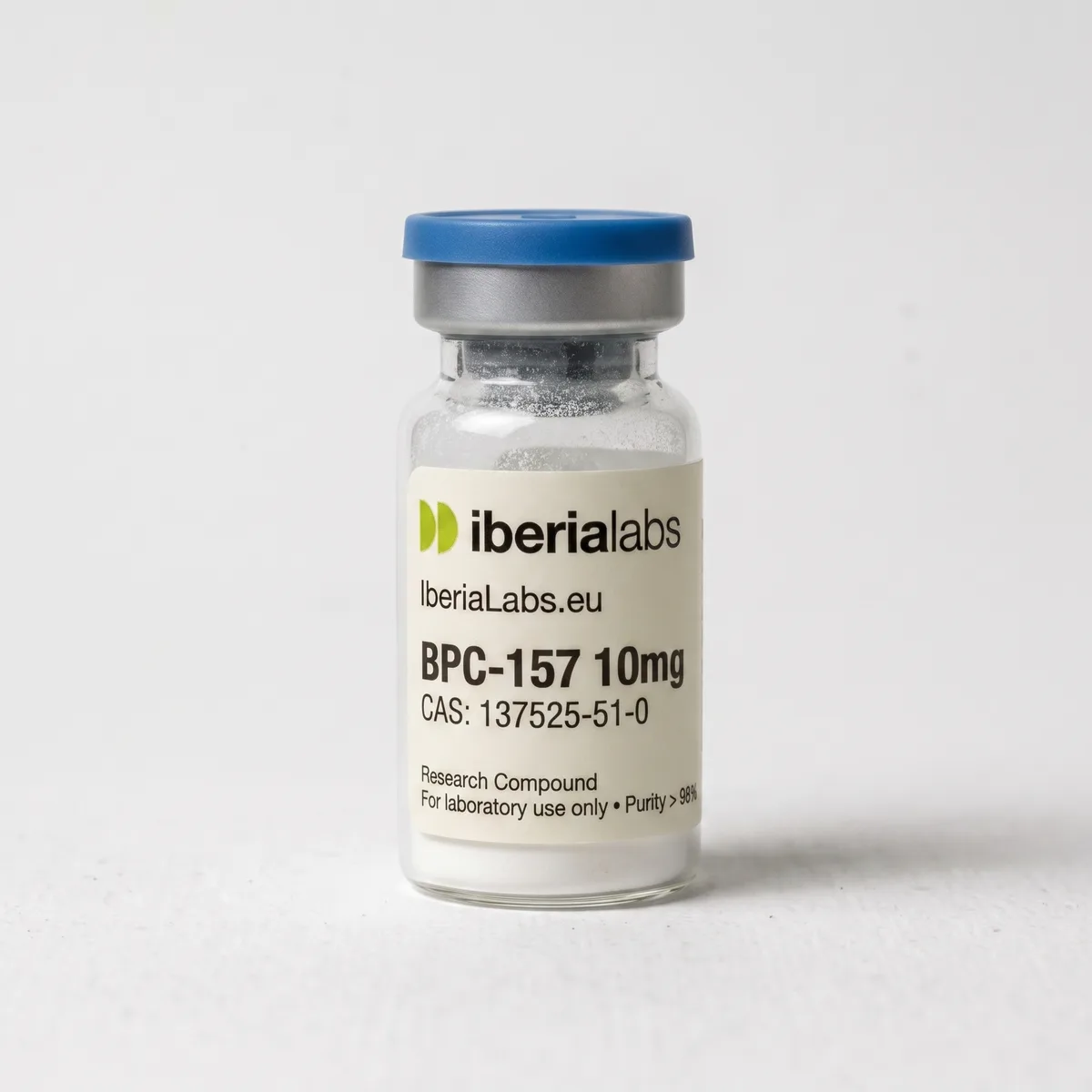
BPC-157: The Acid-Stable Pentadecapeptide for Systemic Tissue Regeneration
BPC-157 (Body Protection Compound-157) is a synthetic pentadecapeptide investigated for its systemic cytoprotective and regenerative properties.60
Structural Parameters of BPC-157
| Property | Value and Specification | References |
|---|---|---|
| CAS Number | 137525-51-0 (free base); 216441-37-1 (acetate) | 63 |
| Molecular Formula | C62H98N16O22 | 60 |
| Molecular Weight | 1419.56 g/mol (average free base) | 60 |
| Sequence | Gly-Glu-Pro-Pro-Pro-Gly-L ys-Pro-Ala-Asp-Asp-Ala-Gl y-Leu-Val | 60 |
| Isoelectric Point | 3.76 | 60 |
Origin, History, and Research Stage
BPC-157 is a 15-amino acid sequence derived from a larger, protective cytoprotective protein found naturally in human gastric juice.60 It was first isolated and characterized in 1992 by Dr. Predrag Sikiric and his team at the University of Zagreb School of Medicine in Croatia.62 Despite extensive preclinical research, BPC-157 has not progressed through standard Phase 2 or Phase 3 human clinical trials.70 In 2022, the World Anti-Doping Agency (WADA) added BPC-157 to its prohibited list under category S0.69 In late 2023, the US FDA categorized it as a Category 2 bulk drug substance, restricting compounding pharmacies from legally dispensing it under section 503A .
Mechanism of Action and Pharmacokinetics
BPC-157 is highly stable in gastric juice, resisting enzymatic degradation and acidic conditions.60 Its mechanism of action involves several tissue repair pathways: ● Angiogenesis: It upregulates vascular endothelial growth factor receptor 2 (VEGFR2) in endothelial cells, activating the Akt-eNOS pathway to promote capillary formation and deliver nutrients to damaged tissue.62 ● FAK-Paxillin Modulation: It modulates focal adhesion kinase (FAK) and paxillin complexes, which are essential for fibroblast migration and survival at wound sites.62 ● Gene Expression: It upregulates the transcription of early growth response 1 (EGR1) and its co-regulator NAB2, which are critical for collagen type I deposition in connective tissues.62
Scientific and Clinical Effects
Preclinical rodent studies show that BPC-157 accelerates the healing of torn ligaments, transected muscles, and ruptured tendons (e.g., the Achilles tendon).62 In the gastrointestinal tract, it heals drug-induced ulcers, reverses intestinal fistulas, and protects the mucosal barrier.63 However, because BPC-157 is highly pro-angiogenic, researchers have raised concerns that long-term use could accelerate the vascularization and growth of latent tumors.66 Human clinical studies remain limited to small, non-randomized, or retrospective case series, which cannot support definitive therapeutic claims.64