Melanotan I: The Stabilized alpha-MSH Analog for Systemic Photoprotection
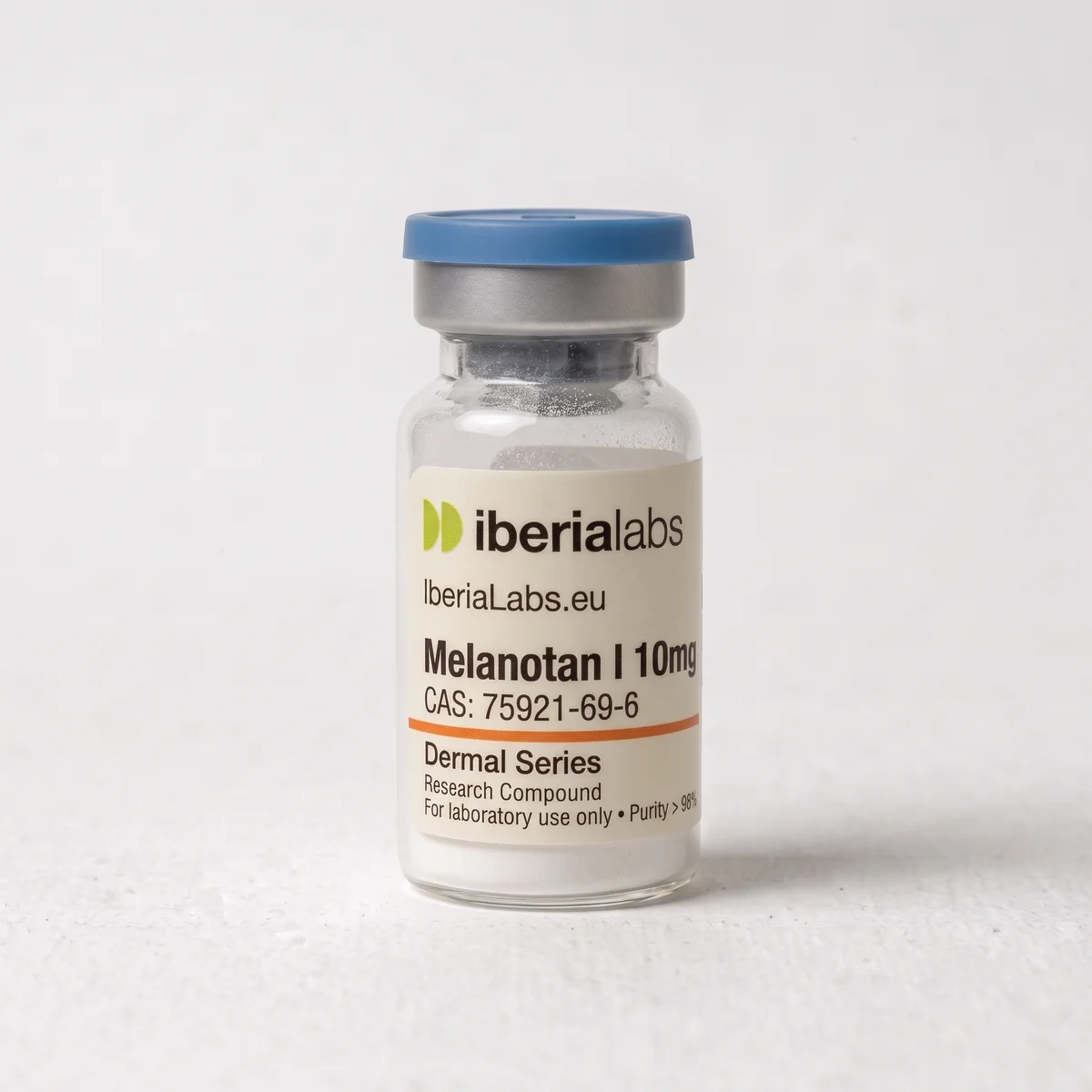
Melanotan I (generically known as Afamelanotide) is a synthetic, stabilized analog of the endogenous alpha-melanocyte-stimulating hormone (alpha-MSH).27
Structural Parameters of Melanotan I
| Property | Value and Specification | References |
|---|---|---|
| CAS Number | 75921-69-6 (free base); 1566590-77-9 (acetate) | 26 |
| Molecular Formula | C78H111N21O19 (free base) | 26 |
| Molecular Weight | 1646.85 g/mol (free base); 1706.88 g/mol (acetate) | 26 |
| Sequence | Ac-Ser-Tyr-Ser-Nle-Glu-Hi s-D-Phe-Arg-Trp-Gly-Lys-P ro-Val-NH2 | 27 |
| Routes | Subcutaneous (inactive orally) | 30 |
Origin, History, and Research Stage
Melanotan I was developed in the 1980s at the University of Arizona by a research team led by Victor J. Hruby and Mac E. Hadley.30 The project was initiated to create a medical technology capable of darkening skin to protect against UV-induced skin cancer without requiring sun exposure . The licensing rights were acquired by Clinuvel Pharmaceuticals.33 Clinuvel pursued regulatory approval for the rare orphan disease erythropoietic protoporphyria (EPP). The European Medicines Agency (EMA) approved the drug in 2014, and the US FDA granted approval in October 2019 under the trade name Scenesse . It is administered as a controlled-release subcutaneous implant .
Mechanism of Action and Pharmacokinetics
Melanotan I is a non-selective melanocortin receptor agonist, binding with high affinity to the melanocortin 1 receptor (MC1R) on melanocytes.26 The peptide sequence replaces Met4 with Norleucine (Nle) and L-Phe7 with D-Phenylalanine (D-Phe), yielding the chemical structure of modified alpha-MSH.35 This design provides steric protection against immediate proteolytic cleavage, prolonging receptor binding compared to native alpha-MSH.35 MC1R binding activates Gs proteins, stimulating adenylate cyclase and increasing intracellular cyclic AMP (cAMP).35 This signal cascade upregulates the transcription factor MITF, which enhances the expression of tyrosinase.35 Tyrosinase shifts melanin synthesis from the yellow-red feomelanin to the black-brown eumelanin.35 Eumelanin is then packaged into melanosomes and transferred to surrounding keratinocytes.26
Scientific and Clinical Effects
Subcutaneous administration of Melanotan I induces a uniform, UV-independent tan.30 In EPP patients, the synthesized eumelanin acts as a physical barrier that filters out visible blue light and long-wave UV radiation, preventing phototoxicity, photophilic cell destruction, and skin pain.31 Pharmacokinetic profiles indicate complete bioavailability post-subcutaneous injection, with a short plasma half-life of 30 minutes, though its physiological effects persist for weeks due to the durability of the melanin pigment.37