GHK-Cu: The Copper-Coordinated Tripeptide for Tissue Remodeling and Regeneration
GHK-Cu is a naturally occurring tripeptide complex highly regarded in regenerative medicine and cosmetology for its tissue remodeling, anti-inflammatory, and wound-healing properties.19
Structural Parameters of GHK-Cu
| Property | Value and Specification | References |
|---|---|---|
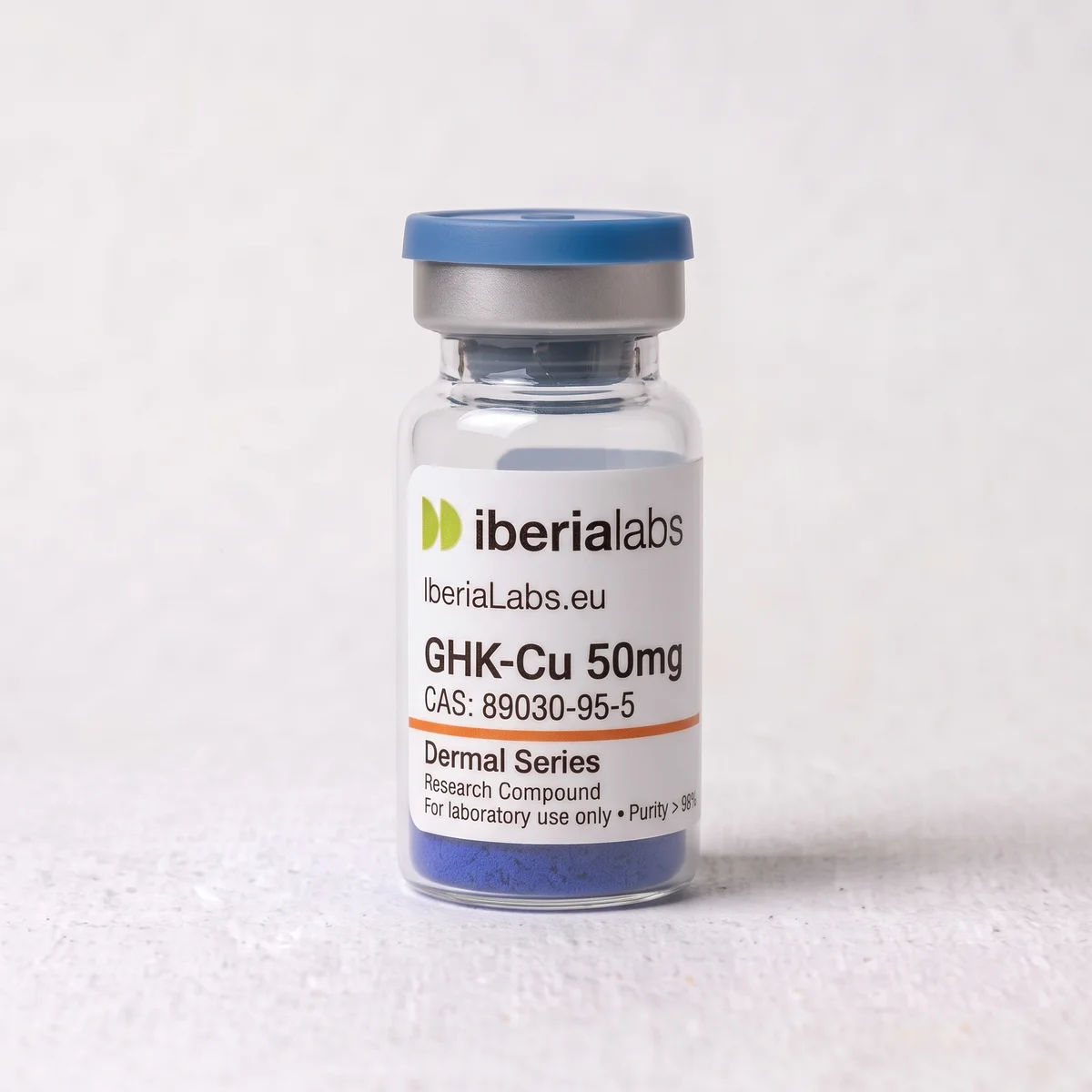
| CAS Number | 49557-75-7 (complex); 89030-95-5 (free tripeptide) | 20 |
| Molecular Formula | C14H22CuN6O4 (complex); C14H24N6O4 (free tripeptide) | 20 |
| Molecular Weight | 403.90 g/mol (complex); 340.38 g/mol (free base) | 20 |
| Chemical Composition | Glycyl-L-Histidyl-L-Lysine tripeptide chelated with Cu2+ | 18 |
| Physical Appearance | Blue to blue-green crystalline powder | 18 |
Origin, History, and Research Stage
The tripeptide GHK was first isolated from human plasma in 1973 by Dr. Loren Pickart.18 Dr. Pickart identified that GHK concentrations decline with age (from 200 ng/mL at age 20 to 80 ng/mL by age 60).18 He demonstrated that chelating GHK with copper divalently (Cu2+) dramatically accelerated wound healing and tissue repair.18 GHK-Cu was adopted by the cosmetic industry in the early 2010s.18 By 2024–2026, it has crossed over into the systemic longevity and nootropics communities.18 It is currently formulated as a premium cosmetic ingredient and studied in early-phase trials for lung injury, bone healing, and neuroprotection.18
Mechanism of Action and Pharmacokinetics
GHK-Cu functions as a high-affinity transition metal chaperone, chelating Cu2+ in a 1:1 molar ratio to form a stable, square-planar coordination complex.19 This complex facilitates the cellular uptake of copper, a critical cofactor for key enzymatic systems, including superoxide dismutase (Cu/Zn-SOD) and lysyl oxidase.19 At the genomic level, GHK-Cu modulates the expression of over 4,000 human genes, shifting them toward a healthier profile.19 It upregulates the transcription of collagen types I, III, IV, and VII, elastin, and glycosaminoglycans via SP1 and TGF-beta pathways.19 Simultaneously, it downregulates matrix metalloproteinases (MMPs) and suppresses pro-inflammatory cytokines such as TNF-alpha, IL-1, and NF-kB.19
Scientific and Clinical Effects
In vivo models indicate GHK-Cu accelerates wound contraction, re-epithelialization, and systemic tissue healing.20 In dermatology, it reduces fine lines, wrinkles, and hyperpigmentation.19 On the scalp, it stimulates hair follicle proliferation and blocks 5-alpha-reductase, offering a gentler, multi-action alternative to minoxidil for androgenetic alopecia.19 Emerging neurological studies also demonstrate neuroprotective effects, showing reduced brain water content and neuronal death in models of intracerebral hemorrhage.18